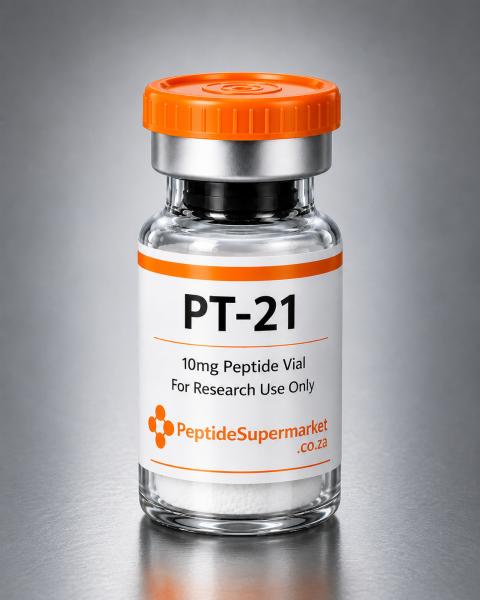
Live prices from 2 SA suppliers, from R570.00, compared side by side so you never overpay.
Copy the code — you'll paste it at checkout.
with our exclusive code
You're about to visit an external supplier
with our exclusive code
By clicking "Continue", you acknowledge that you understand and accept the above. Read our full disclosure.
Compare 1 price for P21. Cheapest: R750.00. Average: R750.00.
| Compare | Visit | |||||||
|---|---|---|---|---|---|---|---|---|

Crono Pharm
Best
P21 |
R750.00 | R150.00/mg | In Stock | R150.00 |
Lab Tested
|
— |
More ways to compare P21
Different views of the same live SA pricing, tuned for how you like to shop.
Compare another peptide
All purchases are made directly from third-party suppliers; your relationship is solely with them. We accept no liability for the quality, purity, or legality of any products listed.
We may earn a commission when you click through to a supplier and make a purchase. This does not affect pricing information displayed.
By using this site you accept responsibility for ensuring purchases comply with applicable laws in your jurisdiction. Read our full disclosure.
P021 | CNTF-Derived Neurogenic Peptide
P21 is a nootropic peptide derived from ciliary neurotrophic factor (CNTF) that enhances neurogenesis and cognitive function. It contains an adamantane moiety that enables blood-brain barrier penetration. Research shows it increases BDNF expression, inhibits LIF signaling to promote neurogenesis, and reduces tau and amyloid pathology in Alzheimer's disease models. Remarkably, P21 can boost neurogenesis in diseased brains above levels seen in healthy untreated brains.
P21 operates through multiple pathways: it inhibits leukemia inhibitory factor (LIF) signaling, removing a key roadblock to neurogenesis and shifting the brain toward a more embryologic state favoring neuron growth. It increases brain-derived neurotrophic factor (BDNF) expression and activates the BDNF/TrkB/PI3-K/AKT/GSK3β pathway. This pathway modulation improves cognitive function and reduces tau and amyloid pathologies.
P021 markedly reduced tau pathology, attenuated Aβ generation, and rescued episodic memory impairment in 3xTg-AD mice.
Treatment during synaptic compensation period can prevent neurodegeneration and reduce mortality.
Robust attenuation of tau pathologies through BDNF/TrkB/PI3-K/AKT/GSK3β pathway.
Enhances dentate gyrus neurogenesis so effectively it exceeds levels in healthy untreated brains.
Enhances memory processes through increased BDNF and restored synaptic function.
May reduce natural decline in learning and memory in aged models by rescuing neurogenesis deficit.
Restores synaptic deficits in cortex and hippocampus.
Rescues deficits in neuronal plasticity.
P21 has not yet been tested in human clinical trials. Research protocols in animal models use subcutaneous or intraperitoneal injection. The adamantane moiety enables blood-brain barrier penetration for CNS effects.
| Goal | Dose | Frequency | Route |
|---|---|---|---|
| Research protocol | Variable by study | Daily | SubQ or IP |
Different nootropic mechanisms; may complement each other.
Both promote neurogenesis through different pathways.
No known negative interactions; different mechanisms.
Different cognitive enhancement mechanisms.
BDNF elevation begins
Neurogenesis enhancement measurable
Cognitive improvements in research models
Disease-modifying effects in AD models
Journal of Alzheimer's Disease
P021 markedly reduced tau pathology, attenuated Aβ, rescued episodic memory, and reduced mortality in AD mice.
Neuropharmacology
Disease-modifying effect via BDNF/TrkB/PI3-K/AKT/GSK3β pathway; rescued neurogenesis and cognition.
Neurobiology of Aging
May reduce age-related cognitive decline by restoring BDNF expression and synaptic function.
Alzheimer's Research & Therapy
Beneficial effects in preclinical studies make P21 highly promising for AD drug development.
Plain-English guides and study summaries from published literature.
Be the first to know when prices drop on your favourite peptides
No spam. Unsubscribe anytime. We respect your privacy.