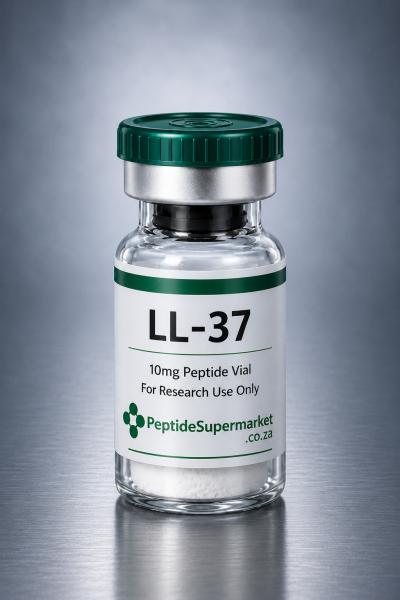
Live prices from 6 SA suppliers, from R430.00, compared side by side so you never overpay.
Copy the code — you'll paste it at checkout.
with our exclusive code
You're about to visit an external supplier
with our exclusive code
By clicking "Continue", you acknowledge that you understand and accept the above. Read our full disclosure.


Compare 7 prices for LL-37. Cheapest: R430.00. Average: R830.71.
| Compare | Visit | |||||||
|---|---|---|---|---|---|---|---|---|

Helix Collective
Best
LL-37 5mg |
R430.00 | R86.00/mg | In Stock | R170.00 |
—
|
— | ||
|
LL-37 5mg |
R459.00 | R91.80/mg | In Stock | R250.00 |
—
|
— | ||
|
LL-37 5mg |
R650.00 | R130.00/mg | In Stock | R120.00 |
—
|
— | ||
|
LL-37 5mg |
R700.00 | R140.00/mg | In Stock | R90.00 |
Lab Tested
|
— | ||
|
LL-37 5mg |
R813.00 | R162.60/mg | In Stock | R185.00 |
Lab Tested
|
— | ||
|
LL-37 5mg |
R813.00 | R162.60/mg | In Stock | R170.00 |
—
|
— | ||
|
LL-37 Pen |
R1,950.00 | R390.00/mg | In Stock | R185.00 |
Lab Tested
|
— |
More ways to compare LL-37
Different views of the same live SA pricing, tuned for how you like to shop.
Compare another peptide
All purchases are made directly from third-party suppliers; your relationship is solely with them. We accept no liability for the quality, purity, or legality of any products listed.
We may earn a commission when you click through to a supplier and make a purchase. This does not affect pricing information displayed.
By using this site you accept responsibility for ensuring purchases comply with applicable laws in your jurisdiction. Read our full disclosure.
Human Cathelicidin | Antimicrobial Peptide
LL-37 is the only human cathelicidin antimicrobial peptide, a 37-amino acid cationic peptide derived from hCAP18 that exhibits broad-spectrum antimicrobial activity against bacteria, viruses, and fungi while modulating immune responses.
Provides direct antimicrobial activity through membrane disruption, promotes wound healing by enhancing keratinocyte migration and angiogenesis, and modulates immune responses without systemic exposure when used topically.
68% ulcer area reduction demonstrated with 0.5mg/mL concentration in clinical trials.
Enhanced granulation tissue formation and wound closure.
Accelerated healing demonstrated in animal models.
Boosts natural immune defenses against pathogens.
Active against MRSA and multi-drug resistant bacteria with >4 log reduction in biofilms.
Balances immune responses without causing immunosuppression.
Stimulates skin cell growth and regeneration.
Promotes new blood vessel formation for tissue repair.
Supports collagen production for wound healing.
Topical application is the most established route, providing direct access to wound sites with minimal systemic exposure.
| Goal | Dose | Frequency | Route |
|---|---|---|---|
| Wound healing - Standard | 0.5mg/mL gel/cream | Daily to twice weekly | Direct wound application |
| Wound healing - Intensive | 1.6mg/mL gel/cream | Daily | Direct wound application |
Subcutaneous injection provides systemic distribution for immune modulation. Limited clinical data compared to topical.
| Goal | Dose | Frequency | Route |
|---|---|---|---|
| Systemic immune support | 100-150mcg | Once daily | SubQ |
Enhanced wound healing through complementary mechanisms.
Combined anti-inflammatory and healing effects.
FICI values 0.25-0.5 against resistant bacteria when combined.
Acts as cofactor for endogenous LL-37 production.
Safe combined use with no negative interactions.
High salt concentrations may reduce antimicrobial activity.
Physical incompatibility, especially with IV formulations.
Reduced bacterial load, initial wound bed preparation
Increased granulation tissue formation, epithelial migration
Significant wound size reduction
Continued healing toward wound closure
International Journal of Antimicrobial Agents
Comprehensive review of broad functions from infection to cancer immunity.
Wound Repair and Regeneration
68% ulcer area reduction demonstrated at optimal doses in chronic venous leg ulcers.
Intratumoral LL-37 in melanoma patients demonstrated safety and immune stimulation (NCT02225366).
PLOS ONE
>4 log reduction in MRSA biofilms compared to conventional antibiotics.
Journal of Biological Chemistry
NMR spectroscopy determining 3D structure of LL-37.
Plain-English guides and study summaries from published literature.
Be the first to know when prices drop on your favourite peptides
No spam. Unsubscribe anytime. We respect your privacy.