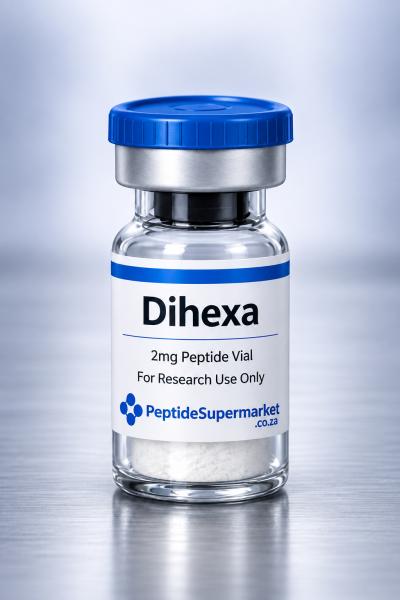
Live prices from 2 SA suppliers, from R550.00, compared side by side so you never overpay.
Copy the code — you'll paste it at checkout.
with our exclusive code
You're about to visit an external supplier
with our exclusive code
By clicking "Continue", you acknowledge that you understand and accept the above. Read our full disclosure.

Compare 2 prices for Dihexa. Cheapest: R550.00. Average: R725.00.
| Compare | Visit | |||||||
|---|---|---|---|---|---|---|---|---|

Crono Pharm
Best
Dihexa |
R550.00 | R55.00/mg | In Stock | R150.00 |
Lab Tested
|
— | ||
|
Dihexa 10mg |
R900.00 | R90.00/mg | In Stock | R250.00 |
—
|
— |
More ways to compare Dihexa
Different views of the same live SA pricing, tuned for how you like to shop.
Compare another peptide
All purchases are made directly from third-party suppliers; your relationship is solely with them. We accept no liability for the quality, purity, or legality of any products listed.
We may earn a commission when you click through to a supplier and make a purchase. This does not affect pricing information displayed.
By using this site you accept responsibility for ensuring purchases comply with applicable laws in your jurisdiction. Read our full disclosure.
Synaptogenic Peptide | Cognitive Enhancement
Dihexa is a synthetic oligopeptide derived from angiotensin IV that potently enhances cognitive function by promoting synaptogenesis. It is 10 million times more potent than BDNF at promoting synapse formation through HGF/c-Met receptor activation.
Binds to hepatocyte growth factor (HGF) with high affinity (Kd = 65 pM) and potentiates its activity at c-Met receptor, activating PI3K/AKT pathways and promoting new synaptic connections with extraordinary potency.
Hexanoyl-Tyr-Ile-Ahx-NH2
Improvements in spatial, working, and consolidation demonstrated across animal models.
Enhanced acquisition through increased synaptic plasticity.
Restoration in impairment models including scopolamine-induced amnesia.
Reduced amyloid burden in Alzheimer's models.
Decreased neuroinflammation and glial activation.
Protection of synapses in neurodegeneration models.
3-fold increase in dendritic spine formation demonstrated.
Increases brain-derived neurotrophic factor expression.
Promotes new blood vessel formation in brain.
Oral capsules/tablets are the most convenient form. Take in the morning with or without food. No reconstitution required.
| Goal | Dose | Frequency | Route |
|---|---|---|---|
| Standard cognitive enhancement | 8-10mg | 1x daily (morning) | Oral |
| Low-dose maintenance | 5mg | 1x daily | Oral |
| Intensive learning protocol | 10-15mg | 1x daily | Oral |
Subcutaneous/intraperitoneal injection provides more consistent dosing. Requires refrigerated storage after reconstitution.
| Goal | Dose | Frequency | Route |
|---|---|---|---|
| Research protocol | 0.5mg/kg daily | Daily or 3x weekly | SubQ/IP |
| Standard injectable | 2-5mg total | 1x daily | SubQ |
Topical cream formulation with limited research data. Experimental route.
| Goal | Dose | Frequency | Route |
|---|---|---|---|
| Topical application | 10-20mg cream | 1x daily | Inner forearms, shoulders (rotate sites) |
Enhanced cognitive benefits; monitor for overstimulation.
Synergistic effects; watch for neural overstimulation.
Different mechanisms; no negative interactions known.
Both affect neuroplasticity strongly; avoid concurrent use.
Some stack for cognition; limited safety data.
Complementary mechanisms for cellular health.
Both potently neuroactive; may cause overstimulation.
Different targets; no known interactions.
Subtle cognitive shifts; possible headaches during adaptation
Improved focus and memory formation
Peak cognitive benefits and enhanced learning
Effects may persist for days to weeks after discontinuation
Clinical Development
Phosphate pro-drug of Dihexa currently in Phase 2 clinical trials for Alzheimer's and Parkinson's disease.
Intraperitoneal injection at 0.5mg/kg/day completely reversed scopolamine-induced cognitive deficits (p<0.001), with performance indistinguishable from healthy controls.
Dihexa restored spatial learning and memory in Morris water maze tests, increased neuronal cells and synaptophysin expression, reduced neuroinflammation.
Demonstrated to be 10 million times more effective than BDNF at promoting synapse formation through HGF/c-Met receptor activation.
Plain-English guides and study summaries from published literature.
Be the first to know when prices drop on your favourite peptides
No spam. Unsubscribe anytime. We respect your privacy.